
Farmers Know the Land. PCM Helps Them Know the Numbers.
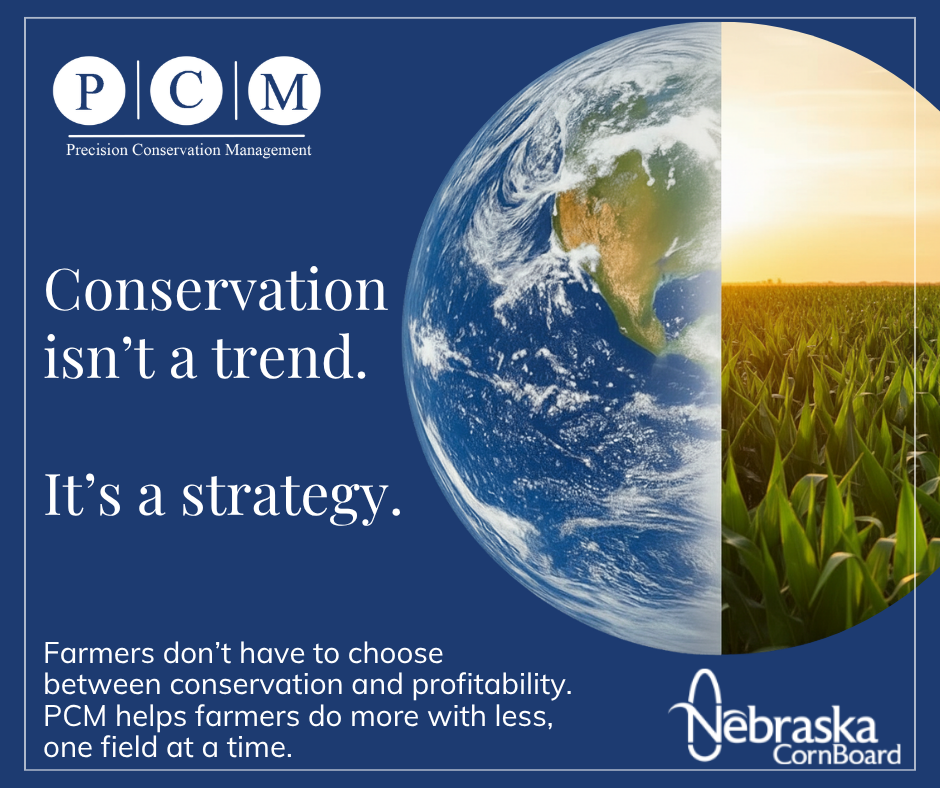
The Nebraska Corn Board partners with PCM to bring free, field-level conservation and profitability analysis to Nebraska farmers. This Earth Day, we’re featuring one of the specialists doing that work, and a farmer who has been applying PCM data to how he farms.
Ask Jeff Huffman what good farming looks like, and you’ll hear him talk about balance.
“How can I make my land, soil, and fields better with the correct economic balance to maintain or increase profitability without sacrificing productivity?” says the Lincoln County, Nebraska farmer. “That’s always been the question.”
It’s the question that defines what stewardship actually means on a working farm. Not conservation as an ideal, but conservation as a long-term strategy.
Precision Conservation Management (PCM) was built by farmers, for farmers to address that question specifically.
Data-Backed Decisions
Nebraska farmers like Jeff have been making conservation-minded decisions for years. What PCM brings to the table isn’t the inspiration; it’s the evidence.
Each year, farmers enrolled in PCM receive a Resource Analysis and Assessment Plan (RAAP Report) that delivers a field-by-field analysis of their tillage strategies, fertilizer use, irrigation, and more, looking at both environmental and economic impacts.
“This report provides information about your operation that you might not know,” says Darren Cudaback, PCM Conservation Specialist serving the Gothenburg, NE region. “It also shows a comparison to other farms and practices in your region.”
The questions farmers bring to RAAP meetings are practical ones: Is my fertilizer investment paying off? Was it more profitable to strip-till or no-till corn last year? “That’s when I can stop talking and let the data speak for itself,” Cudaback says. “Farmers lean in. They start connecting dots between what they tried and what the numbers show.”
For Jeff, the conservation work he’s done over the years has translated into a tangible benefit: “Being a good steward of my land has helped me spend less on inputs,” he says. That’s an important piece of the puzzle for farmers trying to maintain margin in 2026.
Land Stewardship Is a Long Game
Jeff is candid about what conservation looks like from inside an operation. The returns aren’t always immediate. His advice to neighbors who are skeptical: widen the lens.
“Sometimes conservation and profitability are at odds with each other when you look at it short term,” he says. “The costs of conservation sometimes do outweigh the profit in a one- or two-year view. I would encourage farmers to look at it over a 5–7 year time horizon instead of just looking at it today or this year.”
PCM’s field-level data analysis is built to support exactly that kind of thinking, giving farmers a clear picture of how their in-field decisions are performing over time and across their fields.
Free Support for Nebraska Farmers, Backed by Nebraska Corn
What makes PCM different? There’s nothing to buy and no practice change required.
“We’re a nonprofit backed by your state commodity organizations,” Cudaback says. “We’re not here to sell you anything.”
The Nebraska Corn Board’s partnership with PCM is how that support reaches Nebraska farmers directly — at no cost. It’s a tangible investment in the farmers who are already doing the work of stewardship, giving them the data and the technical support to do it with even more confidence.
As Cudaback puts it, the RAAP Report “is more than a year-end summary. It’s a tool to help you farm more profitably, more efficiently, and more confidently.”
That’s what good stewardship looks like with the numbers to back it up.
Ready to see what your field data can tell you? Learn more or enroll at PrecisionConservation.org/farmers.